10 Best 4 Way Crossovers Of 2026
4 Way Crossovers — Reviews, Recommendations & Updated Buying Guide November 2026


Taramp's CRX4 4-Way Electronic Crossover for Guitar
Why We Love It


PRV Audio Crossover Car Audio EX4.6 PRO 4 Way or 3 Way
Why We Love It

Behringer CX 3400 V2 Super X Pro Crossover
Why We Love It
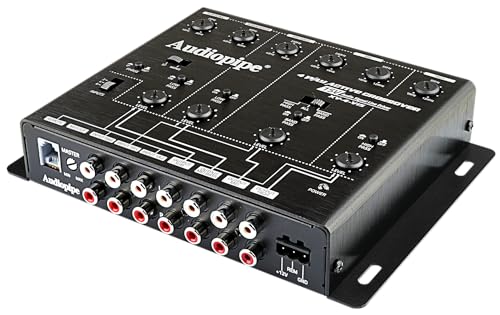
Audiopipe 4-Way Active Crossover (XV-4-V15)
Why We Love It

4 Way Crossover for Speaker
Why We Love It

Cryfokt 4 Way Crossover Filter High Performance 180W Sound
Why We Love It

4 Way Crossover for Speaker
Why We Love It
Quick Pick
10 Best 4 Way Crossovers Of 2026
Quick Pick
Taramp's CRX4 4-Way Electronic Crossover for Guitar, Bass, Keyboard, Drum, All; Black Solid State Amplifier; Musical Instrument Crossover; 4 Channels, 4 Bands; 12dB / 8; 190 x 145 x 40mm; 0.56 kg
PRV Audio Crossover Car Audio EX4.6 PRO 4 Way or 3 Way Electronic Crossover 9 Volts, 4 in 6 Out RCA Channels Car Sound Processor - EX4.6PRO
Behringer CX 3400 V2 Super X Pro Crossover, CX3400 V2
Audiopipe 4-Way Active Crossover (XV-4-V15), Multiplier Switch, Compact, Power LED Indicator, Subwoofer Bass Boost, Custom Installation, Remote Bass Knob
4 Way Crossover for Speaker, 120W 4-8 Ohm 4 Way High & Midrange with Dual Low-Frequency Divider, HiFi Solderless Audio Speaker Upgrade for Home Stereo
Cryfokt 4 Way Crossover Filter High Performance 180W Sound Frequency Divider for KTV Speakers 1 Treble 1 Alto 2 Bass
4 Way Crossover for Speaker, 400W Hi-Fi Grade Dual High & Low Frequency Speaker Dedicated 4 Way Crossover, Audiophile-Level Home Theater Audio Frequency Divider
Buying Guide: 4 Way Crossovers
📋 Table of Contents
1What are the key specifications to look for in a 4-way crossover?
Look for a crossover with at least 4 distinct ports, typically labeled for different signal types like RCA, 3.5mm, or optical. Ensure it has a balanced circuit design and high-quality internal components to prevent signal degradation, especially for audiophiles or home theater users.
2How does a 4-way crossover differ from a 2-way crossover?
A 4-way crossover splits audio signals into four frequency ranges — typically bass, lower midrange, upper midrange, and treble — allowing for more precise speaker management. This is ideal for complex speaker setups, while 2-way crossovers handle only bass and treble, making them simpler but less detailed.
3What type of crossover is best for a home theater system?
A passive 4-way crossover is best for home theater systems with multiple speakers, as it allows for fine-tuned frequency distribution. Active crossovers, which require external amplification, are better for high-end setups where signal control is critical and more flexibility is needed.
4What should I consider regarding impedance matching?
Ensure the crossover is compatible with your speakers' impedance, typically 4, 6, or 8 ohms. Mismatched impedance can lead to poor sound quality or even damage to your speakers or amplifier. Look for crossovers that specify a wide range of compatible impedances or are adjustable.
5Are there any common mistakes to avoid when buying a 4-way crossover?
Avoid crossovers with low-quality capacitors or inductors, as they can cause distortion or failure over time. Also, don’t skimp on build quality — a well-shielded, durable crossover ensures better signal integrity and longevity, especially in high-power audio systems.
How we choose
Our editors are people who genuinely love testing and writing about products. We compare each product's real-world usability and strengths, then distill what matters most into our own "Why We Love It" points — so you get an honest, at-a-glance sense of what counts before you buy.